The motorbike
All about Pam
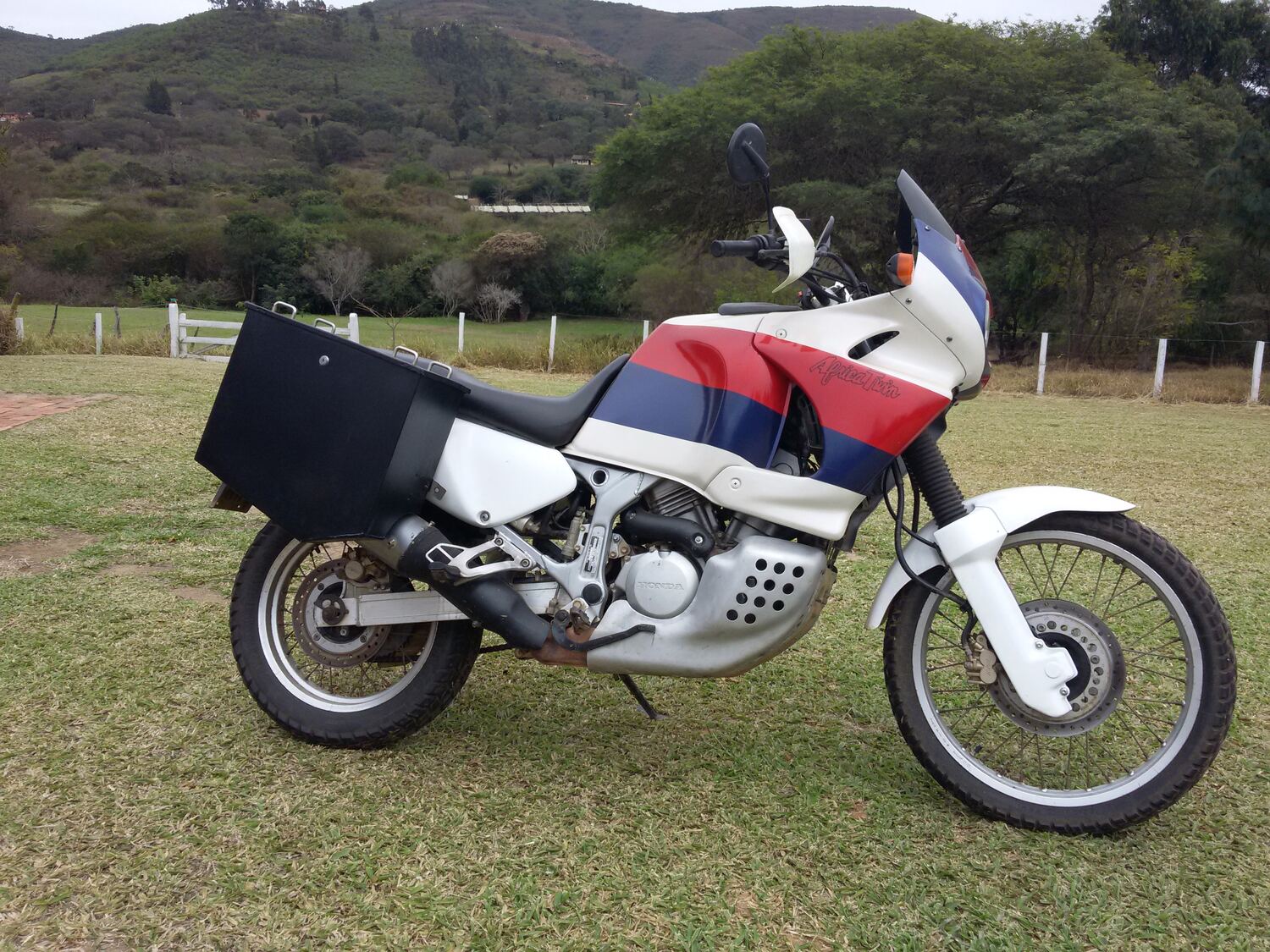
Pam is a Honda XRV750 Africa Twin, model RD07A built in 1996. Even though she is a pretty sturdy bike, a few modifications were necessary. Traveling around the world can not be compared with day to day street use.
Modifications

Windscreen spoiler
The windscreen of the Africa twin is not to well designed. It looks good, but due to it's shape it creates a lot of turbulence-noise around the head. Since I absolutely hate earplugs and don't like headaches I needed an alternative solution. I found it in the form of a small spoiler that sits on top of the windscreen. As small as it is, it works pretty well.
Rear view mirrors
When the bike falls down, and this happens, the first thing that gets damaged is the rearview-mirror. Originally they are mounted in the clutch and brake-handles, so there is also a risk of them breaking. To prevent all this I mounted a set of small mirrors directly on the handlebar. The view to the rear is a lot less, but it will always be available.

Windscreen support bracket
Due to the extra weight of the windscreen-spoiler and possibly also due to the less than smooth roads that I had traveled for 15.000 miles in Asia, the windscreen started to break. In Bangkok (Thailand) I fitted a 'windscreen support bracket' made by Yut (Dynamic motors) to eliminate further movement (and damage). It worked so well that another 15.000 miles later the entire windscreen/instrument/headlight-support broke. But after that weak-point was re-enforced with half a kilo of steel, no further problems arose.
GPS and trip computer
A GPS (Global Positioning System) tells you at any time, at any place, exactly where you are, where you are going and where you should be going. Especially in deserts that can be a useful bit of information. The Garmin GPS V I have mounted on the handlebars is water-proof, shock-proof and idiot-proof. That means even I can use it, but despite all that modern technology I am still able to get lost. The trip-computer tells me daily mileage, average speeds, riding-times etc. More important, it tells me how much more I can go on the fuel I have left.

Tank topbag
A safe place (crash-wise) to keep the camera. Also a handy place since it's always in reach (as long as you sit on the bike). A handy feature is a map-window on top. Too bad it's less than water-proof. I've lost a few maps due to 'water disolvement'.
K&N air filter
The world can be a dusty place and 'Africa Twin' air-filters are not available at every street corner. Taking a dozen with me would have forced me to use a sidecar or trailer, but fortunately K&N filters makes a washable air-filter that will last up to one million miles (1.000.000!). If I had to choose again I would probably get a foam filter. It's less vulnerable and can be oiled with any engine oil. The K&N filter needs special oil and that can be a problem.
Tank sidebag
Luggage is a problem if you travel for a long time. You need to bring so many things. These tank-side bags create instantly 18 liters of extra space and they keep your legs out of the wind (and rain). It's a set from Hein Gericke called 'Tuareg' (desert warrior) and they survived three years of terror. I still use them. The only downside: They turn into wings at 140 KM/h.
Horns or claxons
Especially India is famous for it, but there are lots of other places where they come in handy. Extra horns, claxons if you will. Often it's not the biggest vehicle that survives the streets of India. It's the loudest one. Other traffic only pays attention to something that sounds big, and loud equals big. Pam has three horns and a siren. Still, sometimes I could use more. A lot more.
Fork springs
The standard fork-springs of a Africa Twin are not to 'springy'. I mounted a set of WP progressive fork-springs. Pam stands up straight now, even with 35 kilos of luggage and 85 kilos of rider. The rear suspension is good enough. I had to have the shock 'repaired' after 65.000 miles due to the loss of all the oil, but for the rest it's as good as any aftermarket set.
Crashbar
Not only to prevent damage to engine and fairing, but also to hang on or tie-down 'things'. A simple fall, and I had quite a few, can cause a lot of damage. The crash bar prevents all that. Even a 20 KM/h 'slide down the road' did not more damage than a scratched crash bar.
Fuel pump
The original fuel-pump of the Honda Africa Twin is the highest achievement of mal-engineering. When every other brand replaced the 'ignition contact breakers' since they wear almost as fast as you can replace them, Honda introduced them in a different form. 'Fuel-pump contact breakers' and as to be expected, they wear almost as fast as you can replace them. After the second (improved) fuel-pump failed, I replaced the whole system with a electric rotating pump from 'Moghul Carter'.
Luggage net
It sounds daft, but an elastic luggage net is one of the most versatile and handy pieces of 'luggage management' available. Where do you stash your jacket when it gets hot? Where is your bottle of coke? Where are your gloves? All can be (temporary) stashed under the luggage net.
PVC bag
A heavy duty PVC luggage-roll. It's absolutely water-proof, wear-proof and with a 'pack-safe' steel net around it it's also steal-proof. It's flexible of shape and it holds an enormous amount of stuff.
Luggage rack
Originally the Africa Twin has a 'plastic' luggage-rack at the rear. It is pretty good, mine lasted two years of rough roads while fully loaded. It broke at one place, but that did not do anything to weaken it. When I replaced my 'soft side bags' for aluminum panniers a friend (Christian Lang) welded a replacement rack. Strength is the key issue here as racks always seem to break. Made from 10 X 10 X 2 mm steel pipe Pam's luggage rack can not break unless she gets run over by a 200 ton haul-truck.
Silicone seat
Sitting on a bike for three years, eight (or more) hours a day, you either need a steel ass or a good seat. I chose the good seat and had the original one (also called the AT torture table) worked over by Gerd Jungbluth . It was shaped after my ass instead of the other way round and filled with a silicon implant. This is also why the bike is called Pam (short for Pamela).

Aluminium panniers
I started out with 'soft side bags'. It's not that I am convinced that 'soft' is the way to go. It's more the fact that there just is no good pannier-system for the Africa Twin on the market. I was quite happy with the soft bags, but after two years of torture they started to fall apart. In Viedma (Argentina) I designed and build (with the help of Oscar Knecht, Hector Prendes and Christian Lang) a set of aluminum panniers that did not make the AT resemble a moving-truck. The super slim Africa Twin.
Alarm!
I constructed a simple but effective alarm-system from a (extremely loud) siren, a 12 volt relays and the mercury-switch from a central-heating system. The moment the bike is 'straightened up' (taken from the side-stand) all hell brakes loose. It has two downsides: First of all it does not 'reset' after it is triggered. It will continue to 'howl' until the battery is empty. Secondly (and more important) I discovered that hotel-clerks and security-guards are curious people and would like to know how it feels to sit on a bike like Pam. As a result the entire hotel wakes up and I have to get out of bed to 'reset' the alarm. Naturally everybody swears it just started by itself.
Toolset
Three years 'on the road'. That means road-side repairs. I selected all the tools that I needed and got rid of the rest (you would be surprised to see how little you actually need to completely disassemble a bike). Naturally a toolset needs to be stored on (or in) the bike to be of any use, and not (as I found out in the Indian desert) in your hotel room. It can be rather frustrating to realize that your tire-pump is 20 km away when you look at a flat tire.
Drive chain oiler
Unfortunately the Africa Twin still has a drive-chain (opposed to a drive-shaft) and a drive-chain needs maintenance. Lots of it. Mostly it is cleaning and oiling and that is a dirty job that requires a centre-stand (which the AT does not have). There is a alternative called a 'chain oiler'. A small device that deposits minute amounts of oil (one drop a minute) on the rear sprocket from which it is distributed to the chain itself. And all this only when the engine is running. Pam's is a 'Scott oiler' and works on the vacuum of the engine.
